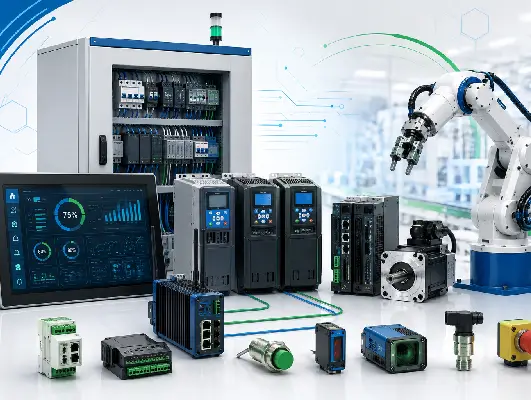
About Industrial Automation Solutions
Industrial Automation Solutions integrate advanced control systems, robotics, sensors, and intelligent software to automate manufacturing and industrial processes. By reducing manual intervention and improving operational efficiency, automation enhances productivity, product quality, and workplace safety. Modern automation technologies enable industries to optimize production, minimize downtime, and achieve consistent performance across a wide range of manufacturing and processing applications.
Industrial Automation is the use of intelligent machines, programmable controllers, sensors, and software to monitor and control industrial operations with minimal human intervention. These systems automate repetitive tasks, improve process accuracy, and provide real-time data for better operational decision-making.
What are the major components of an Industrial Automation System?
An industrial automation system consists of several integrated components that work together to control, monitor, and optimize industrial operations.
1. Programmable Logic Controller (PLC)
The PLC serves as the central controller of the automation system, processing input signals and executing programmed instructions to control machines and industrial equipment.
2. Human Machine Interface (HMI)
The HMI provides a user-friendly interface that allows operators to monitor system performance, configure parameters, receive alarms, and control industrial processes in real time.
3. Sensors and Actuators
Sensors collect real-time information such as temperature, pressure, position, proximity, and motion, while actuators convert control signals into mechanical actions to operate valves, motors, cylinders, and other equipment.
4. Industrial Robots
Robotic systems automate material handling, assembly, welding, palletizing, inspection, packaging, and other repetitive manufacturing tasks with high precision and consistency.
5. Drives and Motors
Variable Frequency Drives (VFDs), servo drives, and industrial motors provide accurate speed, torque, and motion control for automated machinery and production equipment.
6. SCADA System
Supervisory Control and Data Acquisition (SCADA) systems enable centralized monitoring, data acquisition, process visualization, reporting, and remote control of industrial operations.
How Industrial Automation Works?
Industrial automation systems continuously monitor production processes using sensors that collect operational data from machines and equipment. The collected information is transmitted to PLCs or industrial controllers, where programmed logic processes the inputs and determines the appropriate control actions.
The controller then sends commands to actuators, motors, robotic systems, and other field devices to perform the required operations automatically. Operators can monitor system performance through HMI or SCADA platforms, allowing real-time visualization, diagnostics, and process optimization.
By combining intelligent control, machine communication, and real-time monitoring, industrial automation improves production efficiency, reduces manual errors, minimizes downtime, and ensures consistent product quality.
Our BESS Solutions
We offer customized Battery Energy Storage System (BESS) solutions designed for maximum efficiency, safety, and long-term performance. Our systems are engineered to meet the specific energy requirements of industrial, commercial, utility, and renewable energy applications.
Energy Assessment
Analyze energy demand and recommend the ideal BESS configuration.
System Design
Custom battery storage design for safe and efficient performance.
Installation
Professional installation with reliable electrical integration.
Monitoring
Real-time monitoring for battery health and energy performance.
Maintenance
Routine servicing ensures reliable and long-lasting system operation.